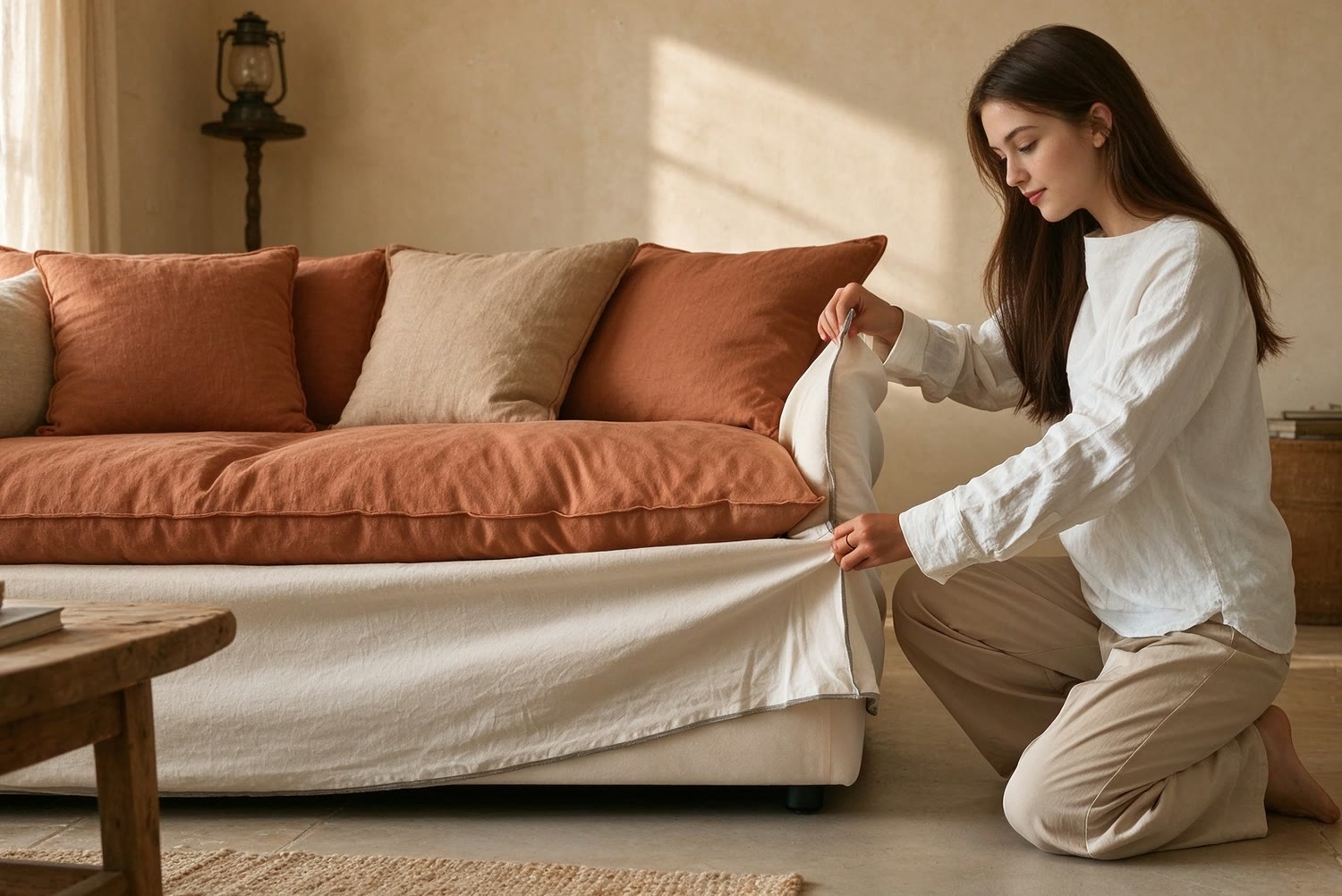
Tailored vs. Loose Fit: How Heavyweight Fabrics & Hidden Velcro Create a Crisp Silhouette
A slipcover sofa can photograph beautifully in a catalogue and still look tired by the second week on a showroom floor. The reason is almost never the fabric pattern. It is fit and weight: a cover cut with slack, over a light fabric, has nothing to hold it in place, so every seat leaves a crease and every crease becomes a fold.
This is the difference buyers describe as “tailored” versus “loose”, and it is decided long before the cover reaches the container.
Fit is a specification, not a style
A loose cover is cut to clear the frame with room to spare. That slack is what lets the cover shift when a customer sits down, and it is why the same sofa looks crisp in the morning and rumpled by closing.
A tailored cover is cut closer, but closeness alone is not enough — a tight cover over a light fabric will simply pull out of shape at the seams instead. Two things have to be right together:
- The allowance at the frame. Too little and the cover fights the upholstery; too much and it hangs.
- The weight of the cloth. A heavier fabric holds its own line, so the cover keeps the shape it was cut to instead of following every movement underneath.
What fabric weight actually does
Weight is quoted in grams per square metre (GSM). The qualities we keep in stock sit in three bands — the full table, with roll widths and abrasion results, is on the fabric page:
| Quality | Weight | Abrasion |
|---|---|---|
| 100% linen | 450 gsm | 40,000 Martindale |
| 100% cotton | 630 gsm | 35,000 Martindale |
| 100% hemp | 650 gsm | 40,000 Martindale |
A 450 gsm linen is the lightest of the three and the one buyers most often associate with the relaxed, washed look. It is also the quality that punishes a loose cut hardest, because linen has little natural bulk to fill out a fold. Cotton at 630 gsm and hemp at 650 gsm carry more body: seams sit flatter, the cover falls in straighter lines, and a customer who has just stood up leaves less behind.
Heavier is not automatically better. Weight has to be supported by the seam and by the frame, or the cover sags at the corners instead of wrinkling at the seat. That is why the two decisions belong together.
Seams carry the shape
Our seam standard covers three constructions — regular, French and baseball — and the choice changes how a cover behaves at the edge.
A French seam encloses the raw edge inside a folded seam, so the inside of the cover is as clean as the outside. On a slipcover this matters twice: the cover is removed for washing, and a raw or overlocked edge frays a little more with every cycle. A regular seam is faster and cheaper, which is the right choice where the edge will never be seen. A baseball seam is a deliberate, visible detail: it reads as a construction feature and adds a line of stitching across the surface.
Whatever the seam, the tension it creates is what keeps the cover square to the frame after a season of use.
How the cover stays put
A tailored cover needs a closure that holds tension without showing. Our covers use two: a concealed zip that runs down one seam so the cover can come off for washing, and a hook-and-loop fastening strip (Velcro) under the frame that pulls the hem down and keeps it there. Neither is visible once the cover is on.
The combination is what survives a showroom floor. A zip alone lets the bottom edge ride up as customers sit and stand; a hook-and-loop strip alone would hold the hem but make the cover awkward to remove. Together the cover closes in one line and the hem stays square to the frame through a full day of sitting.
One practical note for buyers: both closures wear out before the fabric does. Ask which part is replaceable, and whether a spare closure strip ships with the cover — on a rental or hospitality account, that is the difference between a five-minute fix and a re-cover.
What to ask before you specify
When you compare slipcover suppliers, four questions separate a showroom-ready cover from a catalogue one:
- What is the cut allowance at the frame? Ask for the cover measured on a sample, not the frame dimensions.
- What GSM is the fabric you quoted? A price per metre means little without the weight and the abrasion result.
- Which seam, and is it inside or outside? The inside finish is what survives washing.
- How does the cover stay put at the base? This is the part that decides whether a sofa looks tailored at 6pm on a Saturday. On our covers it is a concealed zip plus an under-frame hook-and-loop strip.
How we handle it
Every cover is cut to the frame it belongs to, sewn in the quality the buyer selects, and checked on a sample before bulk. Samples take about 45 days, bulk production about 30 days for standard models and 60 days for custom work, FOB Shanghai, with mixed containers welcome.
If you are choosing between a relaxed look and a tailored one, send us the fabric you have in mind and the dimensions you are working to — we will tell you which cut that cloth will hold. The models we build this way are listed on the slipcover sofa page.
Tell Us the Fabric and the Frame
Send the fabric you are considering and the dimensions you need; we will tell you which cut it holds and quote it FOB Shanghai.
Get in Touch