How to Make Our Fabric Slipcover Sofa More Durable: Suitable Sewing Seams Standard
A slipcover is only as strong as its seams. No matter how beautiful the fabric or how perfect the fit, if the seams fail, the whole cover is compromised. That's why at Hanleide Furniture, we put serious thought into choosing the right seam construction for every slipcover we make.
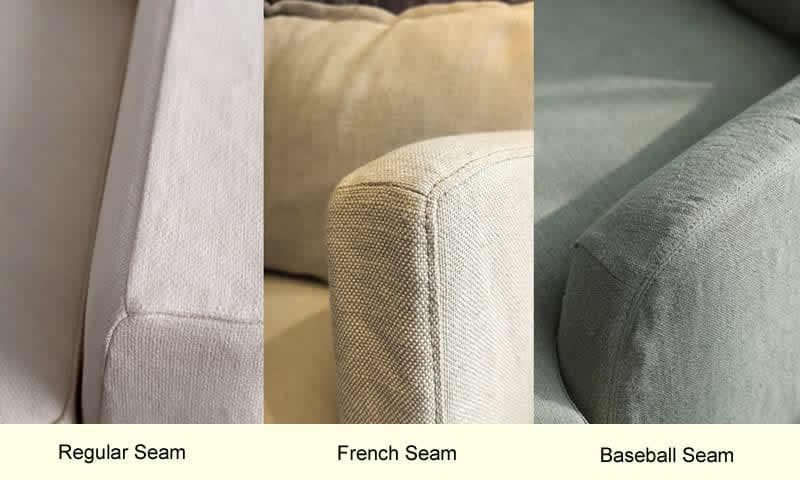
There are three main seam types we use: Regular Seam, French Seam, and Baseball Seam. Each has its own strengths, and the right choice depends on the fabric's physical properties — its weight, weave, stretch, and fraying tendency.
1. Regular Seam — The Workhorse
The Regular Seam is our go-to for most standard fabrics. It's a simple, clean construction where two fabric pieces are joined with a single line of stitching, then the raw edges are finished to prevent fraying. It offers good strength for medium-weight cotton and linen blends, and it keeps the seam profile flat — important for areas where the slipcover needs to sit smooth against the sofa. We use 10 stitches per inch for Regular Seams to ensure consistent holding power.
Best for: Cotton, cotton-linen blends, and medium-weight woven fabrics with moderate fraying tendency.
2. French Seam — The Clean Finish
The French Seam is an enclosed seam — the raw edges are completely hidden inside a second line of stitching. This makes it exceptionally neat and durable, especially for lightweight or loosely woven fabrics that tend to fray badly. The double-stitch construction adds extra strength at the seam line. However, it creates a slightly bulkier profile, so we reserve it for fabrics where fraying is a real concern. Our standard is 8 stitches per inch for French Seams.
Best for: Lightweight linen, sheer fabrics, and materials with high fraying tendency.
3. Baseball Seam — The Heavy-Duty Choice
The Baseball Seam (also called a lapped seam) is our strongest option. It's constructed by overlapping two fabric edges and stitching through all layers — similar to the seam on a baseball. This creates a thick, reinforced joint that can handle significant tension. It's ideal for heavy fabrics and high-stress areas like armrest corners and seat cushion seams. We stitch Baseball Seams at 8 stitches per inch to balance strength with flexibility.
Best for: Heavyweight fabrics, high-stress areas, and thick upholstery materials.
Our Stitch Standards at a Glance
We strictly follow these stitch density standards for every slipcover we produce:
- Regular Seam — 10 stitches per inch
- French Seam — 8 stitches per inch
- Baseball Seam — 8 stitches per inch
These numbers aren't arbitrary. They're the result of years of testing and real-world use, calibrated to give each seam type the optimal balance of strength, flexibility, and fabric compatibility.
Matching Seam to Fabric
The real skill lies in matching the right seam to the right fabric. A heavy linen might perform beautifully with a Baseball Seam but would be unnecessarily bulky with a French Seam. A lightweight cotton that frays easily needs the protection of a French Seam but would be over-engineered with a Baseball Seam. We evaluate each fabric's weight, weave density, stretch percentage, and fraying tendency before deciding which seam construction to use.
And we don't stop at seam type. We pair every seam with high-tenacity polyester thread — specifically chosen for its strength, UV resistance, and compatibility with each fabric family. The thread is just as important as the seam itself; a weak thread will fail regardless of how well the seam is constructed.
The result? Slipcovers that hold up through years of use, washing, and re-fitting — without seam failure. It's one of the many details that sets Hanleide apart.
Want Slipcovers That Last? Let's Talk.
Contact Hanleide Furniture to discuss your custom slipcover project. We'll help you choose the right fabric, seam construction, and thread for your needs.
Get in Touch